


As an airline pilot based in the U.S., I do not get to choose when I retire. Regulation sets that date at 65. No tapering off, no cutting back to part-time hours the way a doctor or a solicitor might in later life. That lack of choice has made me pay far closer attention than most to a risk that catches many retirees off guard: sequence of returns risk, the danger that the order in which investment returns arrive, not just their average, can determine whether retirement savings last.
The Same Average, Two Very Different Endings
Here is a simple test. Imagine two portfolios, each starting at the same value and each experiencing the same set of annual returns over a decade, but one portfolio receives them in reverse order. If neither portfolio takes any withdrawals, both end up in exactly the same place. The order never mattered, because nothing had to be sold at the wrong moment. Figure 1 shows this using real S&P 500 returns with dividends reinvested.
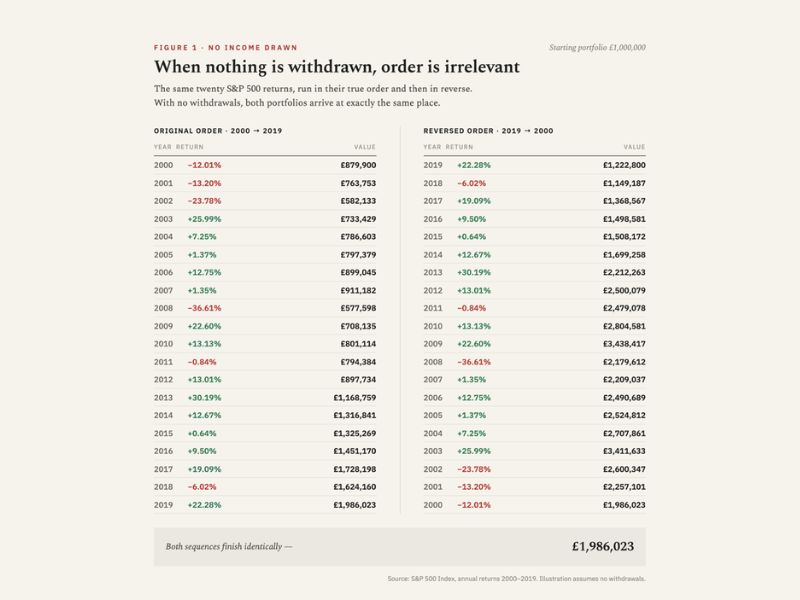
Retirement changes that completely. The moment an income is drawn from a portfolio, assets must be sold to fund it, and a downturn early in that drawdown period forces the sale of a much larger share of the portfolio than the identical downturn would if it arrived later. Money that has already been withdrawn and spent never gets the chance to recover, no matter how strong the following years turn out to be.
What This Looks Like With Real Numbers
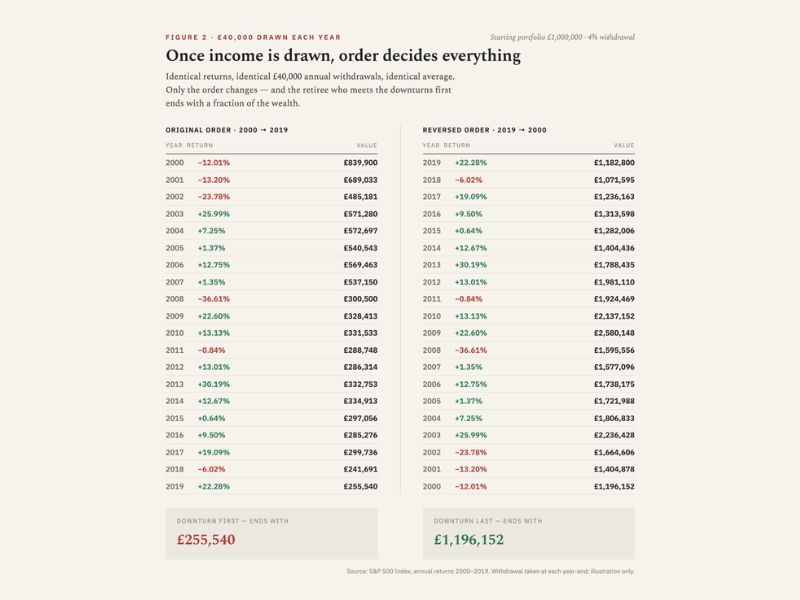
The illustration below will again use the real, dividend-reinvested returns of a broad equity index from 2000 to 2019, a period that includes both the dot-com crash and the 2008 financial crisis.
Suppose a retiree begins with a portfolio of £1,000,000 (currency doesn’t matter) and withdraws £40,000 a year, a commonly cited four percent withdrawal rate, adjusted over time. Retiring straight into the dot-com crash and then the 2008 crisis leaves roughly £276,000 after twenty years, with £800,000 withdrawn along the way.
Now reverse the order of exactly those same annual returns, so the strong years of the mid 2010s arrive first and the weak years arrive at the end instead. Same withdrawals, same average annual return, entirely different outcome. The portfolio ends the period with roughly £1.3 million, nearly five times what the first sequence left behind. Raise annual withdrawals to £50,000 and the original sequence runs out of money entirely by year sixteen, while the reversed sequence still leaves more than £1 million after twenty years. Nothing about the underlying investments changed. Only the order did.
Why This Matters More for UK and European Retirees Today
Since pension freedoms arrived in the UK in 2015, far more retirees have been drawing directly from invested pension funds through drawdown rather than buying an annuity that removes this risk by guaranteeing income for life. Similar shifts toward defined-contribution pensions across much of Europe have moved responsibility for managing this risk from employers and insurers onto individual savers. In the United States, investors have been dealing with this shift since defined contribution 401(k) plans overtook company-provided pensions decades ago.
Combine that with retirements that can now easily stretch beyond thirty years, and the odds of a serious downturn landing in the first decade of drawdown, when the pension pot is typically at its largest, are higher than many people assume.
What Actually Helps
Speculative assets are not the answer. Too many investors assume that some new asset class will solve the problem. It will not. The tools that genuinely help are considerably less exciting.
Cash held outside the pension, whether in savings accounts, ISAs, a laddered set of fixed-term deposits, or short-dated bonds, is the single most effective buffer. If cash can be used during a down-market year instead of selling pension assets at depressed prices, it avoids locking in a loss that may never be recovered. Using the same illustration above, simply skipping pension withdrawals in the six negative years and drawing from cash instead would have left the portfolio roughly £650,000 ahead by year twenty. Even after accounting for the cash spent to cover those years, the retiree would still be £410,000 ahead. That is the value of flexibility, and it only works if the cash is already in place before it is needed.
Reducing debt before retirement, particularly clearing or reducing a mortgage, matters more than many people realize. Essential fixed costs are what force withdrawals in years when the portfolio should ideally be left alone. The lower the fixed costs going into retirement, the more room there is to wait out a bad market.
A sensible allocation to bonds also helps, though it is not a complete solution on its own. Government bonds have historically shown roughly half the volatility of equities, with far shallower worst-case years. But moving entirely into bonds at retirement creates its own risk, since a multi-decade retirement still needs growth assets to avoid running out of money altogether. The goal is balance, not retreat.
The Discipline of Planning for the Range, Not the Average
Nobody controls the order in which markets deliver returns, in the same way I do not control the weather on any given flight. What can be controlled is preparation for a range of outcomes rather than a single expected one. A cash buffer, manageable fixed costs, and a sensible mix of growth and defensive assets will not guarantee good markets in the first years of retirement. They will, however, give a retirement plan a genuine chance of surviving the bad ones, which is ultimately the only scenario that matters.