


The economic resilience of developed nations depends on more than a single variable; it is the result of a delicate equilibrium between fiscal policy, workforce productivity, technology adoption, and capital allocation. Yet, among these dynamics, the demographic shift—specifically an ageing population—stands out as the most powerful structural catalyst of the century. This shift is not merely a statistical drift in birth rates and life expectancy; it represents a fundamental reordering of the social contract and the commercial landscapes that underpin national prosperity.
Globally, nations are confronting shrinking tax bases and escalating healthand aged care demands. In Australia, this shift is no longer a distant projection; it is an active economic reality. How Australia manages its aged care policy shifts offers a critical case study in public policy levers, regulatory friction, and untapped commercial innovation. The nation is currently transitioning from a model of passive service consumption to one of active, engaged participation, where the distinction between funded necessity and private-market luxury is becoming increasingly defined by consumer choice and self-funded capacity.
Australia as the Policy Testing Ground
For business leaders and policymakers alike, Australia’s aged care sector serves as a crucial bellwether. The landscape is undergoing a systemic overhaul marked by the Aged Care Act 2024 and the launch of the Support at Home program. This legislative milestone marks a definitive move away from the historical dominance of government-funded models toward a new accountability framework. Under this regime, the concept of the ‘Active Participant’ is central—retirees are no longer viewed merely as recipients of care but as empowered economic actors expected to contribute to their own longevity costs while demanding higher transparency and quality.
The 2024 Act introduces rigorous statutory duties and obligations for ‘Responsible Persons,’ effectively raising the bar for clinical and corporate governance. This shift places significant pressure on providers to demonstrate that they are not just compliant, but that their governance structures are ‘regulator-ready’ at all times. The focus has moved from simple service delivery to a comprehensive rights-based approach, where the statement of rights and code of conduct form the baseline of every interaction. This new economy necessitates a move toward transparency where data integrity—such as Care Minutes and National Quality Indicators—is no longer a reporting chore but a public-facing metric of brand value and trust.
Faced with unsustainable budgetary pressures, the Australian Government is re-engineering public funding mechanisms. By introducing tighter means-testing and shifting co-contribution expectations onto self-funded retirees, policy levers are actively capping public expenditure while compelling consumer co-investment.
This structural shift signals two primary dynamics for B2B executives and investors:
- Funding is transitioning from a growth engine to a baseline safety net.
- The middle-to-upper wealth demographic is being directed toward private, non-funded services.
The Growth Frontier: Opportunities in Non-Funded Services
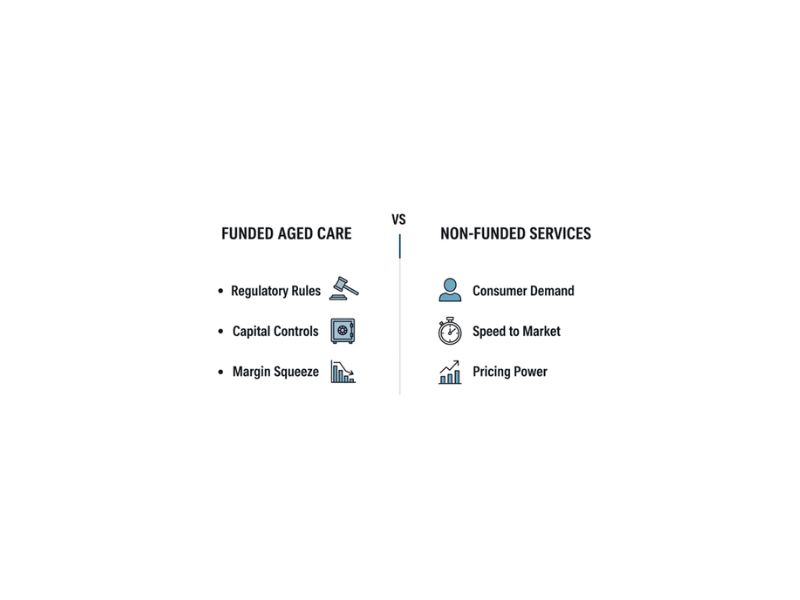
While funded providers wrestle with margin compression, a parallel market is expanding rapidly in non-funded, out-of-pocket services.
When consumers pay directly rather than through government subsidies, consumer behaviour changes: brand, convenience, speed, and quality replace regulatory eligibility as primary purchasing criteria. This shift unlocks massive opportunities across several business sectors, particularly as the demand for premium, lifestyle-based care models continues to outpace traditional, subsidised options. Affluent retirees are increasingly seeking bespoke solutions that integrate seamlessly into their desired quality of life, moving beyond the ‘clinical’ feel of traditional aged care toward a hospitality-led experience.
- Age-Tech & Smart Home Infrastructure: The integration of technology is no longer optional; it is the cornerstone of non-funded growth. Direct-to-consumer monitoring systems, fall detection platforms, and AI-driven home safety technologies are being designed to prolong independent living. These technologies offer peace of mind without the need for immediate government assessments, allowing families to invest in proactive safety measures that enhance the lived experience of ageing in place.
- Private Concierge & Health Logistics: High-end, self-funded care coordination, premium transport, and home-maintenance services tailored to affluent retirees seeking a seamless quality of life.
- B2B Service Partnerships: Enterprises providing outsourced operational, software-as-a-service (SaaS), and workforce management models enabling innovative packaged services.
The trend toward lifestyle-based care is also driving a surge in private concierge and health logistics services. These high-end, self-funded models cater to a demographic that values autonomy and seamless service over purely funded clinical interventions. By decoupling ‘care’ from ‘clinical necessity,’ providers can offer a broader spectrum of services—ranging from premium transport to aesthetic home maintenance—that address the holistic needs of an active ageing population.
The Reality of Funded Aged Care: High Hurdles, Narrow Margins
For organisations operating directly within government-funded aged care, the commercial landscape requires rigorous strategic discipline. Broad market tailwinds do not guarantee profitability. The industry is witnessing a shift toward ‘institutional-grade compliance,’ where the ability to navigate complex regulation is no longer a defensive necessity but an operational differentiator. This level of maturity is what attracts institutional capital and builds the necessary trust with both the regulator and the consumer.
Operating in the funded environment demands navigating complex regulatory requirements, including:
- Strengthened Quality Standards: Heightened accountability around clinical governance, worker screening, and care outcomes.
- Price Controls & Audits: Restrictive pricing caps under funded aged care models that squeeze operating margins.
- Compliance Liabilities: Increased reporting overheads under new rights-based legislation that penalise administrative inefficiency and compliance.
Critical Success Factor: Thriving in funded aged care requires viewing compliance not as an administrative burden, but as a core operational capability. Successful operators rely on software automation, efficient labour management, and lean clinical workflows to protect operating margins.
By framing compliance as a core operational capability, successful providers are able to protect their operating margins through software automation and lean workflows. This ‘institutional-grade’ approach ensures that every aspect of the business—from clinical governance to financial reporting—is evidence-based and stress-tested. In a high-stakes environment where the cost of being wrong is significant, this level of precision becomes a competitive advantage, allowing leaders to focus on growth and innovation rather than constant crisis management.
The Strategic Takeaway for B2B Leadership
The narrative surrounding an ageing population often focuses heavily on fiscal strain. However, for forward-thinking business leaders, it represents a fundamental restructuring of consumer spending, workforce dynamics, technology and service delivery.
The lesson from Australia’s aged care reforms is clear: capital and innovation will increasingly flow toward agile, efficient operators, and those supplying funded services must build institutional-grade compliance capabilities to survive. Organisations that balance regulatory discipline with private-market innovation will be best positioned to lead in the longevity economy.
In this shifting landscape, the Anchor Impact Group (AIG) is emerging as the critical partner for businesses navigating the complexity of both funded and non-funded aged care. Adopting the mantra “Leaders enabling leaders,” the Group provides the strategic stability required to navigate high-stakes regulatory environments through three core pillars.
Anchor Consulting: Triangulating Success. This pillar delivers decision-grade advisory across strategy, finance, and risk. By ‘triangulating success,’ AIG ensures that board-level intent is connected to executive action and operational outcomes. This approach integrates robust governance frameworks with financial viability and capital assurance, particularly vital during mergers or strategic shifts. Central to this is Independent Third-Line Risk Mastery—expert-led audits that identify systemic weaknesses and strengthen clinical governance, transforming risk management into organisational resilience.
Anchor Policy: A Living Architecture. AIG provides a ‘living architecture’ of over 800 meticulously updated documents. This library is designed to move providers beyond generic templates, providing 100% legislative alignment with the 2024 Standards. By reducing the administrative burden on front-line staff and ensuring documents are continuously updated with zero maintenance on the provider’s part, Anchor Policy provides the legislative certainty needed to support high-quality, consumer-centric care.
Anchor Academy: From Awareness to Application. The Academy focuses on enhancing industry capability through targeted education that shifts staff from simple awareness to the practical application of best practices. Whether through on-demand LMS courses or bespoke in-house training, the focus is on behaviour change and leadership elevation. By building the strategic mindset of governing persons and clinical leaders, Anchor Academy ensures that knowledge translates into tangible improvements in quality and compliance, empowering leaders to lead well in the longevity economy.
Cynthia Payne- Founder and Manging Director Anchor Impact Group
www.anchorimpactgroup.com